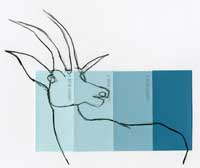
Blue Antelope
biogeographical work by Kate Foster, Hayden Lorimer and Merle Patchett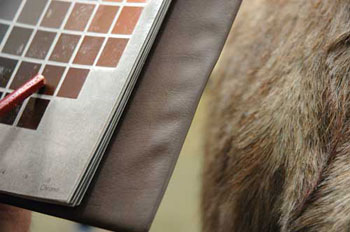
Image © Naturalis RMNH / Kate Foster
The Blue Antelope project began in 2005 with a visit to a stored antler and horn collection in the Hunterian Museum in Glasgow. The specimens were gathered from many continents for zoological study, but were no longer displayed in public. Our question became: how to connect these to the present and future?
One specimen in particular captured attention: the skull and horn cores which were thought to belong to an extinct South African animal, the Blue Antelope. If it really was a Blue Antelope, this would make it an extremely rare specimen (though it could also have been a Sable Antelope). The last representative of Hippotragus leucophaeus was shot c.1800 in what is now the Cape Province of the Republic of South Africa. A few other ‘Bluebuck’ remnants are to be found in old European collections. Closer to where it last lived, ‘Inputi’ remains have been found in archaeological sites in South Africa.
The ambiguity of the history and presence of this remnant provoked ethical, scientific and conservation questions. As an art-geography collaboration, ‘Biogeographies’ looked into this specimen’s unique history and situated it in current historical and critical discourse.
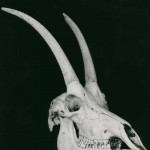
Bluebuck Skull © Hunterian Museum/Kate Foster
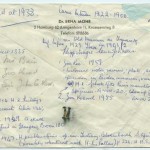
Glasgow/Hamburg 1966 © Hunterian Museum
On scrutiny, the solidity of this item and its photographic record dissolved into ambiguities… Who knows, who knew, about blue antelopes? What other names did it have? Is the Hunterian specimen even a ‘Blaubok’ skull? What would the whole animal have looked liked? Was it slowly going extinct over millennia, or suddenly killed out by settler colonialism? What was its habitat like, then? How was it Blue?
A 2006 Project Website added to the Blue Antelope’s digital afterlife: archive version can be seen here.
Twenty years ago, our attention was focused on ‘the practices and relationships that brought specimens to their state of enclosure.’ Patchett and Foster wrote: ‘Furthermore, we show how attention to the deteriorating materials of taxidermy specimens not only reveals the secrets of their assembly, but exposes the clever artifice and ambiguity of representation. As substances and specimens start to unravel, so too do the bio-geographical stories of their making, showing up tangles of beings, practices and places.’ Abstract for Dead Biogeographies – and how to make them live. RGS/IBG Conference, 2008
By 2026, the Blue Antelope’s status has further unravelled, with all known remains tested against a template of its genetic code. The animal’s afterlife has become a virtual spectre: entangled in versions of conservation where individual species are resurrected through elite technological capacity.
Yet, with a deepening animal extinction crisis worldwide, environmental justice and habitat conservation remain, by far, the most urgent priorities.